

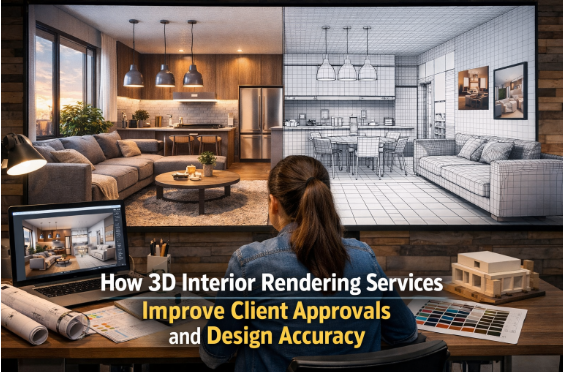

The interior design decisions are usually the most personal and detailed aspects of any architectural project. Colors, materials, lighting, furniture, and the way space flows contribute to how a space feels-and minor misunderstandings lead to major dissatisfaction later on.
That is why 3D interior rendering services have become so important, enhancing both client approvals and the accuracy of designs in modern architecture and real estate projects.
The Challenge in Interior Design Interpretation
Traditional interior drawings, mood boards, and material samples have real value but often require imagination and technical understanding. Most of the clients cannot imagine how individual elements will look and feel together in an actual space.
Typical challenges involve:
- Difficulty with picturing scale and proportions
- Uncertainty over material combinations
- Misinterpretation of lighting effects
- Confusion about the placement of furniture and circulation
Gaps in understanding slow down approvals and result in revisions over and over again.
Turning Concepts into Clear Visuals
3D interior rendering services bridge the gap between abstract ideas and tangible spaces.
Interior renders clearly show:
- Spatial Layout and Room Proportions
- Furniture Scale and Placement
- Material Finishes, Textures, and Colors
- Natural and artificial light effects
This clarity allows the clients to understand the design at once rather than relying on their imagination.
Faster and More Confident Approvals from Clients
The reason is often not that something is wrong with the design itself, but the clients are just not sure. Interior rendering replaces uncertainty with confidence.
Once the client can see realistic visuals of:
- Dwellings, bedrooms, kitchens, and offices
- different times of day with various lighting conditions
- Colour Schemes and Material Combinations
They are more comfortable approving the decisions. This really reduces back-and-forth discussions and shortens the approval timelines.
Improving Design Accuracy Prior to Execution
Interior rendering is a presentation tool, but it is also very strong in the design validation process.
Indeed, interior visualization helps designers in many ways.
- Identify problems involving proportion or scale
- Test furniture layouts and circulation paths
- Assess lighting balance and shadow behavior
- Compare several options of digital design
Refine designs at this stage to avoid costly changes during construction or fit-out.
Aligning Client Expectations with Reality
One of the major risks in interior projects is mismatched expectations by the client versus what the end result actually is. When clients approve the design based on drawings or samples, surprises can be part of this process.
3D interior rendering services reduce this risk by:
- Showing accurate material finishes
- Accurately representing real-world lighting and reflections.
- Depicting furniture and décor to scale
Alignment ensures that what gets approved is closer to what gets built, with fewer changes to protect client satisfaction and project timelines.
Collaborating to Support Interior Design Decisions
Interior renderings provide a common reference that:
- Improves design discussions.
- Helps the consultant understand intent
- Reduces misunderstanding during execution
- Supports clear coordination among teams.
A professional 3D architectural rendering company is one that cooperates with the design team in refining visuals as the designs evolve, keeping accuracy and consistency throughout the process.
Presentation Enhancement: Real Estate & Commercial Projects
Interior views are very important for marketing and leasing by real estate developers and commercial projects, especially before completion.
The interior renderings find broad applications in:
- Sales presentations and showrooms
- Marketing brochures & websites
- Pre-leasing and investor pitches
- Hospitality and retail branding
Reducing Revisions and Costly Rework
Late-stage interior changes are among the most costly and disruptive revisions throughout any project. Interior rendering helps minimize these risks.
By answering key design questions early, teams can:
- Complete Finishes & Layouts Faster
- Reduce site-level changes.
- Avoid material reorders or rework.
- Keep projects on time and on budget.
The cost is usually significantly lower compared to those that are related to correcting built interiors.
Long-term Value of Interior Renderings
Interior renders still have the ability to add value beyond the initial approvals; they can be reused for:
- Ongoing marketing campaigns
- Projects and case study portfolios
- Client presentations on similar projects
- Award and promotion materials
Therefore, it makes interior rendering a long-term asset and not a one-time deliverable.
Why Professional Expertise Matters
Effective interior visualization is all about expertise. A professional 3D architectural rendering company knows:
- Principles of Interior Design and Ergonomics
- Accurate Lighting Simulation
- Realistic materials and textures
- Balance between aesthetic considerations and technical accuracy
This allows the visuals not only to be beautiful but also reliable and buildable.
Meet Modern Client Expectations
Today’s clients expect clarity before committing to major design decisions. It used to be a luxury; now, interior rendering is expected.
Projects that rely exclusively on drawings and samples require longer approval times and bear a greater risk of dissatisfaction.
Conclusion
Success in interior design is about clarity, accuracy, and trust. 3D interior rendering services allow for better client approvals as such designs have become more comprehensible and emotionally appealing; secondly, design accuracy is improved by issue identification made during early stages. Interior rendering does just that-reduces ambiguity, limits changes, and aligns expectations of all involved-while converting conceptual interior ideas into tangible, detailed visuals.
Therefore, interior rendering becomes an influential factor, if provided by a seasoned 3D architectural rendering company, that will make sure the approvals are smoother, the results are better built, and clients are highly satisfied throughout the project life cycle.